Last updated November 17, 2026







Free written scope consultation - allowances, timeline, and change-order rules on paper before a single trade is scheduled
Bathroom Remodeling Warning Signs Every Homeowner Should Know
Grout cracking in a newly remodeled shower isn’t a cosmetic flaw. It’s often the first visible sign that the shower pan was never waterproofed correctly, and water has been moving behind the tile since week one. We’ve seen it in Kendale Lakes more times than we’d like: a beautiful tile job sitting on top of a hidden problem that won’t reveal itself for months. Some warning signs show up around the six-month mark. Others wait until eighteen months, when the damage is already expensive. This guide teaches you what to look for, when to look for it, and how to tell a normal settling crack from a real moisture or structural failure.
Quick Answer
The most reliable bathroom remodeling warning signs are recurring grout or caulk cracks at inside corners and the shower pan, white mineral deposits (efflorescence) on tile or grout, a musty smell that won’t clear with ventilation, soft or spongy floor spots, and tiles that sound hollow when tapped. Each of these points to water or movement where it shouldn’t be, and the earlier you catch them, the cheaper the fix.
Styles & brands we work with
- Kitchen remodeling
- Bathroom remodeling
- Home additions & ADU
- Roofing
- Windows & doors
- Driveway & pavers
- Fence
Table of Contents
- Why Bathroom Remodel Problems Appear in Stages
- Settling Cracks vs. Substrate Failure Cracks
- What Efflorescence Tells You About Water Movement
- Mold Behind the Walls: The Smell, Stain, and Texture Clues
- How to Check If Your Shower Was Waterproofed Correctly
- Floor Movement, Hollow Tiles, and What They Mean
- What a 730-Day Warranty Should Cover
- Kendale Lakes Humidity and Its Effect on Bathroom Builds
Why Bathroom Remodel Problems Appear in Stages
Water damage is patient. A shower that wasn’t waterproofed correctly doesn’t announce itself the day the grout dries. It works slowly through grout lines, behind tile, and into the substrate. In a dry climate you might get a few extra months before the evidence shows. In Kendale Lakes, where summer humidity sits high and afternoon storms push rain against exterior walls, the timeline compresses. A waterproofing failure that might surface at month twelve up north can show itself at month five here.
Here’s the rough shape of how these problems unfold:
- Weeks 1-8: Everything looks perfect. Hairline cracks at inside corners are common and often just normal cure shrinkage.
- Months 2-6: Caulk at the shower pan perimeter starts pulling away. Grout at floor-to-wall transitions cracks repeatedly even after being patched.
- Months 6-12: Efflorescence appears. A faint musty smell develops that doesn’t clear with the exhaust fan. Tile starts to sound hollow when tapped.
- Months 12-24: Soft spots in adjacent drywall, bubbling paint on the wall behind the shower, or a stain on the ceiling of the room below.
We’ve walked into Kendale Lakes homes where the homeowner had been told “that crack is just settling” three separate times over a year. By the time we opened the wall, the cement board was crumbling. The repair went from a $300 caulk-and-grout fix to a full shower rebuild. The signs were there at month three. They were just explained away.
If you’re planning a bathroom remodel and want it built to avoid these failures, our Groundwork Construction Co. of Kendale Lakes home page covers how we structure every project from waterproofing up.
Settling Cracks vs. Substrate Failure Cracks
Not every crack in a bathroom is a warning sign. Some are completely normal. Knowing the difference saves you from panic and, more importantly, keeps you from ignoring a real problem. The key is location, pattern, and behavior over time.
Normal settling cracks
- Hairline cracks (under 1/16 inch) at inside corners where two walls meet
- Thin cracks along the caulk line where the wall tile meets the floor tile – these occur because tile and framing move at different rates
- Cracks that appear once in the first month and don’t grow or reappear after a proper caulk repair
- Fine spiderwebbing in grout on a floor where the subfloor has some expected deflection
Substrate failure cracks (not normal)
- Cracks that reappear within weeks of being patched, especially at the shower pan or curb
- Diagonal cracks running from a corner across tile faces
- Grout crumbling out in chunks rather than cracking in a thin line
- Cracks accompanied by a hollow sound when you tap the tile around them
- Cracks where the tile on either side has started to move or “lip” against its neighbor
- Any crack with moisture, discoloration, or efflorescence nearby
The test is behavioral. A settling crack shows up once, gets repaired, and stays repaired. A substrate crack comes back. In Kendale Lakes, where afternoon humidity keeps the bathroom environment damp, recurring cracks at the shower pan are the single most common early clue that the waterproofing membrane is compromised or was never installed. If you re-caulk the same joint three times in a year, stop caulking and start investigating.
For a closer look at how a properly built shower pan should be assembled, our Home Additions & ADU in Kendale Lakes team applies the same waterproofing standards to new wet areas as we do in a full bathroom renovation.
What Efflorescence Tells You About Water Movement
Efflorescence is the white, chalky, or powdery mineral deposit that appears on tile, grout, or surrounding drywall. It looks like leftover grout haze or hard water staining. It isn’t. Efflorescence is salt carried to the surface by water and left behind when that water evaporates. If you’re seeing it, water is already moving through your wall assembly. That’s the whole story.
On a bathroom wall it means moisture is traveling through the tile, the grout, the backer board, or the framing behind it and depositing minerals on the outside as it dries. The source is almost always one of these:
- A shower pan that lets water escape under the tile instead of draining to the weepholes
- Missing or poorly installed waterproofing membrane behind the tile
- Cracked grout or failed caulk at joints that let water in with every shower
- A plumbing supply or drain leak that’s been slowly weeping behind the wall
- Improperly sloped shower pan that pools water in one spot
The white powder comes back after you scrub it away, usually within a few weeks. That return is confirmation the water source is still active. It’s not cosmetic, and it won’t resolve on its own. In a climate like Kendale Lakes, the evaporation cycle that produces efflorescence happens year-round, so the deposits can appear faster than you’d expect.
A strong exhaust fan helps dry the air, but a fan cannot fix water moving through a wall. If you see efflorescence on the wall side of the shower, plan on opening the wall to inspect. It’s cheaper to look now than to replace framing later.
Mold Behind the Walls: The Smell, Stain, and Texture Clues
Mold is a symptom, not the disease. It grows where water sits. Behind a bathroom wall it can develop for months before you see anything, and by the time you do see it, the underlying moisture problem has usually been active for a long while. There are three clues that surface before visible mold, and each one deserves attention.
The smell
A musty, earthy, or damp-basement odor in a bathroom that clears briefly with the fan but returns within a few hours is the earliest and most reliable indicator. Odor molecules are small. They move through the same pathways as moisture. If the smell lives in the room permanently, moisture lives in the wall.
The stain
Look for pale yellow or brown water rings on the ceiling below the bathroom, on the wall behind the shower, or on the baseboard of the adjacent room. Paint that bubbles or peels on the wall sharing the shower is a strong sign of moisture on the backside of the drywall. On white ceiling paint, look for a faint shadow line that wasn’t there a year ago.
The texture
Push gently on the drywall on the wall behind the shower or on the ceiling below. If it feels soft, spongy, or gives slightly under light pressure, water has been in the paper facing. If it crumbles or “pills” when you rub it, the drywall is compromised. Caulk that never fully dries, or a baseboard that swells and separates after a shower, tells you the same thing.
Mold spores spread readily in humid air, and Kendale Lakes stays humid enough that a small wet cavity can turn into a large mold problem fast. If you notice any of these three clues, the right next step is not a bottle of bleach spray. It’s getting a professional in to open the wall and confirm where the water is coming from. Cleaning the surface without finding the source lets the mold return in weeks.
If you’ve already been through one failed remodel and are considering a rebuild, our Driveway & Pavers in Kendale Lakes crews see the same discipline applied to exterior drainage: away from the structure, every time. The interior principle isn’t different.
How to Check If Your Shower Was Waterproofed Correctly
You can learn a lot without tearing out tile. The checks below are diagnostic only. We’re not describing how to install waterproofing yourself because a shower pan is a place where small mistakes lead to expensive damage, and the materials and layering have a right way to be done. These are the questions to ask and the signs to look for as the homeowner.
1. Ask your contractor what waterproofing system they used – and get it in writing
Every legitimate shower build uses a recognizable system. Common ones include a liquid-applied membrane (RedGard, Laticrete Hydro Ban, Mapei Mapelastic), a sheet membrane (Schluter Kerdi, NobleSeal), or a foam board system (Schluter Kerdi-Board, Wedi). Ask for the product name. If the answer is “we just use cement board and thinset,” that is not a waterproofing system and the shower will eventually leak.
2. Look for documentation from the build
Reputable contractors photograph each stage of the waterproofing before the tile goes on. The pan liner, the curbs, the corners, the flood test. You should be able to see those photos. If they can’t produce any, that’s your answer about how seriously the waterproofing was treated.
3. Look for evidence of a flood test
Before tile goes down, a properly built shower pan gets filled with water and left for 24 hours to confirm the liner holds. If your contractor never mentioned this test, they may not have performed it.
4. Perform the tile-tap test
Tap the tile across the shower wall and floor with a screwdriver handle or a coin. A tight, solid ring sounds like solid concrete behind the tile. A hollow, dead “thud” means the thinset isn’t bonded to the substrate in that area, which often follows a waterproofing failure. Map where hollow spots are so you can track if they spread.
5. Check for proper drainage slope
Pour a couple of cups of water on the shower floor away from the drain. It should flow evenly to the drain without pooling anywhere. Pooling water means the pan was built flat or the drain height is off. Both trap water under the tile.
6. Check the drainage weepholes
The shower drain has small weepholes around its base that allow water trapped under the tile to drain away. They’re often clogged by careless grout or thinset during installation. If you can’t reach them without demolition, ask a professional to evaluate them with a camera or by draining the base.
If any of these checks turn up concerns, the earlier you act the better. What’s a $400 shower pan redo on a fair estimate becomes a $6,000 rebuild once the framing rots.
Floor Movement, Hollow Tiles, and What They Mean
Bathroom floors carry more concentrated water load than any other room in the house. When something is wrong under the tile, the signs usually show up at the edges first: at thresholds, around the toilet flange, and along the wall perimeter.
- Hollow tiles. Tap each tile. A hollow sound means the thinset didn’t bond. On a floor, that usually means the tile is rocking slightly on the substrate and water gets under it every time you mop. Left long enough, the tile cracks and the subfloor gets wet.
- Flexing or bouncing. Step across the floor in different spots. Any perceptible give means the subfloor is deflecting more than tile should allow. That causes cracking where the tile spans joists and can eventually crack the tile itself.
- Grout eroding at the toilet flange. The toilet flange area is a notorious leak zone. If grout around the base of the toilet is missing or crumbling, water from condensation, splashing, or a slow flange leak is likely the cause.
- Loose or rocking tiles at the doorway. Thresholds take constant traffic and are the first place tile separates from thinset when the floor under it is compromised.
- Dark or swollen baseboards. Baseboard near the shower or at the outside wall swelling or separating means moisture from behind, not from the floor surface.
Hollow tiles in one small area may be a cosmetic nuisance. Hollow tiles across a walkway are a failure pattern. If you’re already planning a broader home project, it’s worth knowing how Fence Installation in Kendale Lakes and other exterior work we handle share the same moisture-management principles: keep water moving away from the structure and inspect the joints that matter most.
What a 730-Day Warranty Should Cover
The best protection against every failure we’ve described is a workmanship warranty that actually covers what goes wrong. A two-year warranty on a bathroom remodel is the bar. Anything shorter leaves you paying for a fix on a job that failed on its own. The 730-Day Done Right Promise at Groundwork Construction Co. of Kendale Lakes is deliberately set at that length because the problems in this guide typically surface well within it. If it’s not done right, we make it right.
Here’s the split between what a real warranty covers and what gets written off as “owner negligence.”
A 730-day workmanship warranty should cover:
- Waterproofing failures in the shower pan and walls (leaks, membrane failure, missing membrane layers)
- Cracked tiles caused by improper substrate preparation or inadequate thinset coverage
- Grout failures at inside corners and shower pans that indicate installation error, not settling
- Loose or hollow tiles discovered within the warranty term
- Plumbing leaks originating from connections made during the remodel
- Efflorescence returning after remediation, when the moisture source traces back to a build defect
- Premature failure of materials we supplied (adhesive, grout, caulk, waterproofing membrane)
What gets legitimately excluded:
- Damage from a plumbing leak that originates above the shower (upstairs unit, roof, window)
- Impact damage from dropped objects or standing on things the bathroom wasn’t built for
- Chemical damage from cleaners not intended for natural stone or grout
- Pre-existing conditions the contract excluded and you signed off on (this is why reading the exclusions matters)
The “owner negligence” loophole
Some contractors use the phrase “owner negligence” to deny coverage for any crack, any leak, or any grout failure. If your contract lists broad language like “damage resulting from use” without defining it, you can expect pushback. Read the exclusions before you sign, not after the failure. A reputable warranty names specific covered causes and specific excluded ones. Vague exclusion language is a warning sign on its own.
Ask any contractor you hire to put the warranty in writing, name the duration in days, and state which failure categories are covered. If they hesitate, that’s an answer too.
Kendale Lakes Humidity and Its Effect on Bathroom Builds
Bathrooms in South Florida deal with conditions most of the remodeling advice on the internet doesn’t account for. Humidity stays high year-round, and outdoor moisture pushes against exterior walls every rainy season. That changes what to watch for and when.
- Exhaust fans need to be sized correctly. A bathroom needs a fan rated for its cubic footage, and it needs to vent outside the building, not into the attic. In Kendale Lakes, warm, moisture-laden attic air will find its way back into the house if the fan terminates poorly.
- Waterproofing has zero margin in this climate. A shower that would dry out between uses in an arid climate can stay damp near-permanently here. Any missed seam or incomplete membrane will show up fast.
- Caulk life is shorter. Bathroom caulk in a Kendale Lakes home should be inspected twice a year and reapplied as needed. If you’re reapplying the same joint more often than that, the joint is failing underneath.
- Windows and exterior walls matter. Bathroom walls that share an exterior face are vulnerable to humidity intrusion through failed window seals and cracked exterior caulk lines. If your tile cracks on one exterior wall while other walls stay fine, that’s a hint.
- Air conditioning helps and hurts. The AC dehumidifies, which is good. But if a bathroom is separated from the conditioned envelope (a common issue when an addition was built without proper return air), the room runs hotter and wetter than it should.
When we scope a Kendale Lakes bathroom renovation, the build has to handle the local moisture load, not an average one. James Hardie cement board and the right membrane are the basics; exhaust sizing and the surrounding envelope are what make the difference over years.
Common Mistakes to Avoid
- Accepting “cracks are normal” without inspection. Some cracks are normal and some aren’t. Ask your contractor to identify the reason behind a specific crack, and get the answer in writing. If the answer is a shrug, escalate.
- Repairing caulk over wet substrate. Re-caulking over moisture traps water inside the wall. The joint will fail again within months. Dry the cavity first, or you’re sealing in the problem.
- Trusting a pretty tile job without waterproofing documentation. Tile hides everything. If your contractor can’t show you photos of the waterproofing stage, assume it wasn’t done correctly until you prove otherwise.
- Skipping the flood test. A 24-hour flood test is standard practice. If your contractor didn’t perform it or can’t describe what it is, the shower pan may leak for years before you notice. Kendale Lakes humidity will accelerate the damage once it does.
- Using the wrong exhaust fan. An undersized or improperly vented fan leaves the bathroom damp. Confirm the fan vents through the roof or wall to the outdoors, not into the attic or a soffit.
- Hiring on price alone. A bid that’s 30% below others almost always reflects something missing: no waterproofing membrane, no permit, no flood test, no warranty. The cost of fixing that later dwarfs the savings.
- Assuming your warranty covers it without reading it. Specifically look for a duration in days or years, a list of covered failure types, and a clear process for filing a claim. “Lifetime warranty” with no described coverage is marketing, not protection.
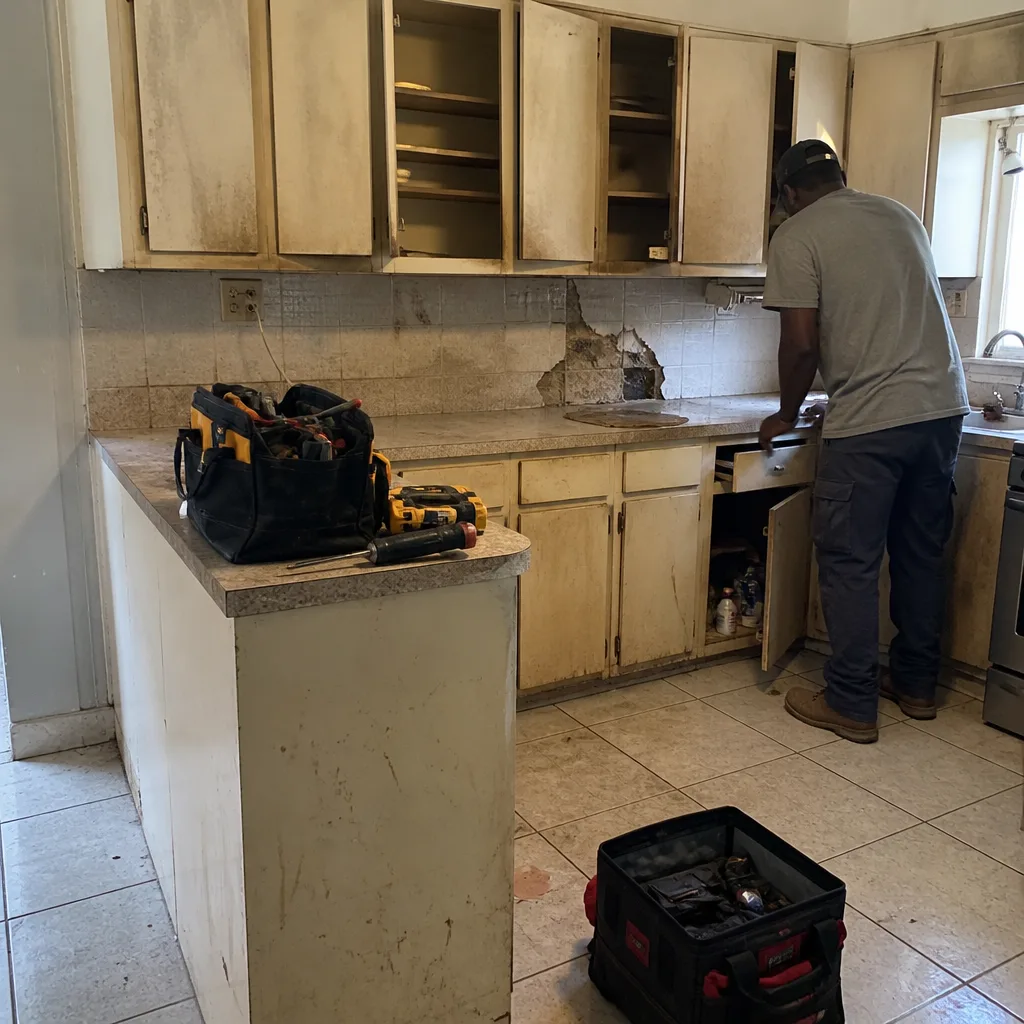
See the difference
 Before
 After
 Before
 After
 Before
 After
When to Call a Professional
Call a professional when any warning sign in this guide is present and recurring: caulk or grout that keeps failing despite repeated repair, efflorescence that returns within weeks of cleaning, hollow tiles that spread, soft spots in adjacent drywall, or a musty smell that won’t clear. Also call if your contractor can’t produce waterproofing photos or the flood test record. These point to failures that could still be small, but only if they’re addressed now. Delaying a six-month problem to eighteen months in a Kendale Lakes bathroom generally turns a $400 fix into a $6,000 rebuild. Groundwork Construction Co. of Kendale Lakes offers free estimates in Kendale Lakes – call (844) 834-8961. We’ll assess what you’re seeing, tell you honestly whether it’s cosmetic or structural, and give you a line-item scope before any work starts.
Frequently Asked Questions
No. Hairline cracks in the first weeks after a remodel are often normal cure shrinkage, especially at inside corners where two surfaces meet. A single crack that appears once, gets properly caulked, and stays repaired is normal. A crack that returns within weeks of repair, or appears at the shower pan and curb, usually points to water in the substrate and requires investigation.
White powder on tile or grout is efflorescence, and it means water is moving through the wall or floor assembly. The powder is mineral salt left behind when that water evaporates. If it returns within weeks of cleaning, the moisture source is active. Call (844) 834-8961 for an assessment – a free estimate will tell you what’s actually going on behind the tile.
Ask your contractor what waterproofing system they used (often a sheet membrane like Schluter Kerdi or a liquid-applied membrane), and ask for photos of the membrane installed before the tile went on. Confirm the shower pan was flood-tested for 24 hours. Then perform a tile-tap test: hollow spots indicate failed bonding, and hollow spots near the shower pan are a red flag. If none of those checks can be satisfied, get a professional to look before the damage grows.
Repair costs depend on what’s failed. A caulk-and-grout repair runs a few hundred dollars. A partial shower rebuild (removing tile, replacing backer board, re-waterproofing, retiling) typically runs a few thousand. A full rebuild with framing repair and new materials runs considerably higher. Kendale Lakes humidity accelerates damage, so an early fix is often a fraction of a late one. Call (844) 834-8961 for a free estimate.
If the waterproofing failed due to workmanship, a proper workmanship warranty should cover it. Read the fine print: any warranty worth having names the duration in days or years and specifies which failure types are covered. “Owner negligence” exclusions are common and can be used to deny any claim, so ask for the covered and excluded lists in writing before signing. The 730-Day Done Right Promise exists specifically so this part isn’t ambiguous.
Most homeowners don’t need to move out during a bathroom remodel, but they do need a working second bathroom and a clear schedule. A single-bath home is a different calculation and worth discussing before signing. A written schedule with a completion date and a line-item scope keeps surprises out of the process. Our free estimate and design consult in Kendale Lakes covers both before you commit to anything.
The Bottom Line
Bathroom remodel warning signs fall into a few categories: cracks that keep returning, efflorescence that comes back after cleaning, musty smells that don’t clear, hollow or soft surfaces, and hollow spots that spread. Each of them points to water in a place it shouldn’t be. Catching them at six months is cheap. Catching them at eighteen months is not. Get the waterproofing documented, take the flood test seriously, and read the warranty so you know what’s covered. If you’re seeing any of these signs in your Kendale Lakes home, call (844) 834-8961 for a free estimate. Live person, 24/7, no voicemail – upfront pricing, no surprises.
Written by the team at Groundwork Construction Co. of Kendale Lakes.