Last updated November 17, 2026



Free written scope consultation - allowances, timeline, and change-order rules on paper before a single trade is scheduled
Driveway & Pavers Maintenance Schedule: What to Do and When
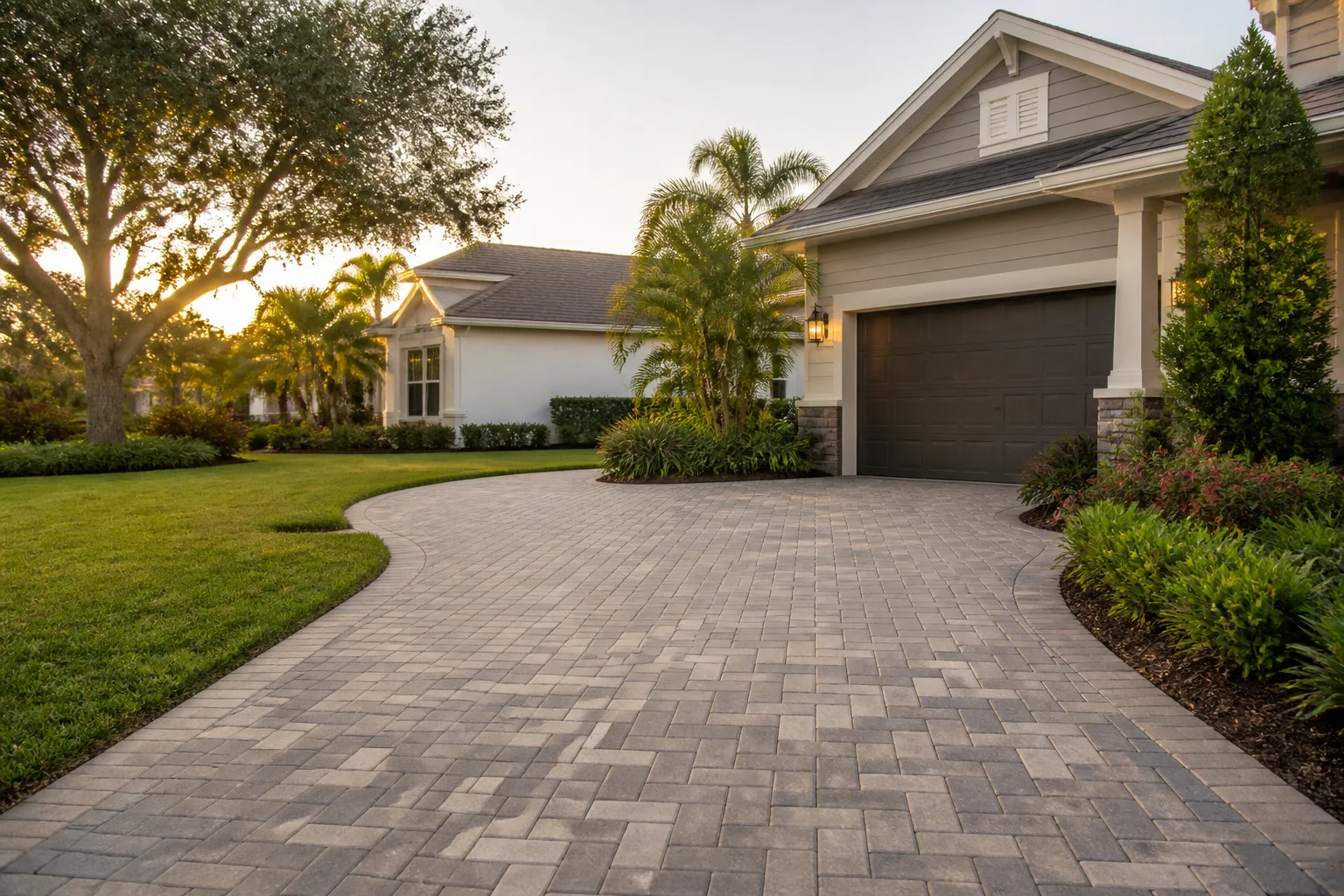
Sealing your pavers at the wrong time of year in South Florida can trap moisture instead of blocking it. That single mistake costs more to reverse than skipping sealer entirely. Most paver maintenance guides are written for a four-season climate with a hard freeze, a thaw, and a dry summer. Kendale Lakes doesn’t have any of those. What we have is a wet season that runs from May through October, a dry season that bakes the joints from November through April, and a hurricane window stacked in the middle. Your maintenance rhythm should follow that calendar, not the one printed in a national how-to. This guide walks through the full year for a paver driveway in Kendale Lakes, month by month, including the pre-storm checklist, the post-storm reset, the water-bead test that tells you whether resealing is real or an upsell, and the five-year inspection items most homeowners never think about until something shifts.
Quick Answer
A paver driveway in South Florida needs three scheduled touchpoints each year, not twelve: a pre-hurricane inspection in May, a post-hurricane reset in November, and a mid-dry-season check in February. Joint sand should be topped off twice a year, weeds and moss handled quarterly in the wet season, and sealer reapplied every two to three years based on the water-bead test, never on a calendar. Everything else is spot work you do when you see a problem.
Styles & brands we work with
- Kitchen remodeling
- Bathroom remodeling
- Home additions & ADU
- Roofing
- Windows & doors
- Driveway & pavers
- Fence
Table of Contents
- Why the Standard Paver Calendar Fails in Kendale Lakes
- The May Pre-Hurricane Checklist
- The November Post-Hurricane Reset
- When Pavers Actually Need Resealing (The Water-Bead Test)
- The Annual Weed and Moss Protocol for Kendale Lakes Humidity
- The 5-Year Inspection: What Homeowners Overlook
- Month-by-Month Schedule at a Glance
- Repair vs. Replace: Reading the Warning Signs
Why the Standard Paver Calendar Fails in Kendale Lakes
Most national paver maintenance schedules assume a freeze-thaw cycle. Up north, winter ice gets into the joints, expands, and pries pavers apart. The spring repair list makes sense there. Kendale Lakes has a different enemy: water that never fully leaves. Our wet season dumps the majority of the year’s rain between May and October, often in short, hard bursts that overwhelm a joint sand bed faster than it can drain. Then the dry season arrives and the same joints that were soaked in September are baking at 90 degrees in March. That wet-dry swing is what causes most of the pavers problems we see in Kendale Lakes, not frost.
There’s a second local factor: our water table sits high. In low-lying pockets around Kendale Lakes, especially older sections where the swale grading has settled, water can pool at the edge of a driveway for hours after a storm. That standing water works on the joint sand and the base simultaneously. A maintenance schedule built for a dry climate simply doesn’t account for it.
Add hurricane season to the mix, and the picture gets clearer. Between June and November, wind-driven debris, palm fronds, roof granules, and storm surge from nearby canals all land on driveways that were perfectly clean in April. The May inspection exists to make sure the pavers can handle that load. The November reset exists to clean up after it. Everything in between is maintenance during the calm.
We’ve seen Kendale Lakes driveways fail prematurely for one reason more than any other: the homeowner followed a generic online guide, sealed in July, and trapped moisture under the sealer during the wettest month of the year. The sealer clouded, the joints stayed wet, and the fix cost more than not sealing at all. The rest of this guide is built to prevent that.
The May Pre-Hurricane Checklist
May is the single most important month for a paver driveway in Kendale Lakes. Hurricane season opens June 1, and the wet season is already underway. Everything you do in May is about making sure the driveway can take three to five months of hard rain and wind without shifting, settling, or losing its joint sand. Work through these items in order.
- Inspect the joint sand line. Walk the driveway and look at the gaps between pavers. Joint sand should sit roughly flush with the paver surface, no more than 1/8 inch below. If you can see daylight down the joint to the base, that sand has washed out and needs topping off before the rain does more damage. This is the highest-priority item.
- Check the edge restraints. The edge restraint is the concrete or plastic lip that holds the outer row of pavers in place. If it has cracked, separated, or been undermined by soil erosion, the entire field of pavers can start to spread under wind and water load. Press on the outer row; it should not move.
- Clear the drainage channels. Most Kendale Lakes driveways drain to a swale or a street gutter. Palm fronds, mulch, and lawn clippings collect in the low spot and block the flow. A blocked channel during a 4-inch rain event can flood the driveway and soften the base underneath it. Clean it out, then check it again after the first big storm.
- Remove debris and check for loose pavers. Loose pavers before the storm become projectiles during it. Walk the driveway, tap each paver with the handle of a screwdriver, and listen for the hollow sound that means a paver has come off its bedding sand.
- Photograph the driveway. Take a full set of photos before the season. If a storm causes damage, an insurer or a repair crew needs a “before” to work from. It also gives you a reference for next year.
If any of these checks turn up a problem, resolve it in May, not June. A driveway that’s structurally sound going into the season comes out of it in far better shape. For heavier repair work, like edge restraint replacement or full resanding, see our Driveway & Pavers in Kendale Lakes page for what that work involves.
The November Post-Hurricane Reset
November is the mirror of May. The wet season is winding down, the storm threat is largely behind us, and the driveway has just absorbed five months of punishment. The goal now is to reset it before the dry season locks in whatever damage the storms caused. This is where the big cost of ignoring paver maintenance shows up, because a small shift from a storm becomes a full lifting-and-relaying job once dry weather bakes it into place.
Here’s the post-season walkthrough:
- Clear all debris. Palm fronds, dead leaves, roof granules, and anything the wind dropped should come off completely. Debris traps moisture against the pavers and stains the surface.
- Pressure wash at the right pressure. A gentle pass at moderate pressure removes storm grime without disturbing joint sand. Too much pressure blasts the sand out and undoes the whole point. If you’re not sure of the right setting, err on the side of lower.
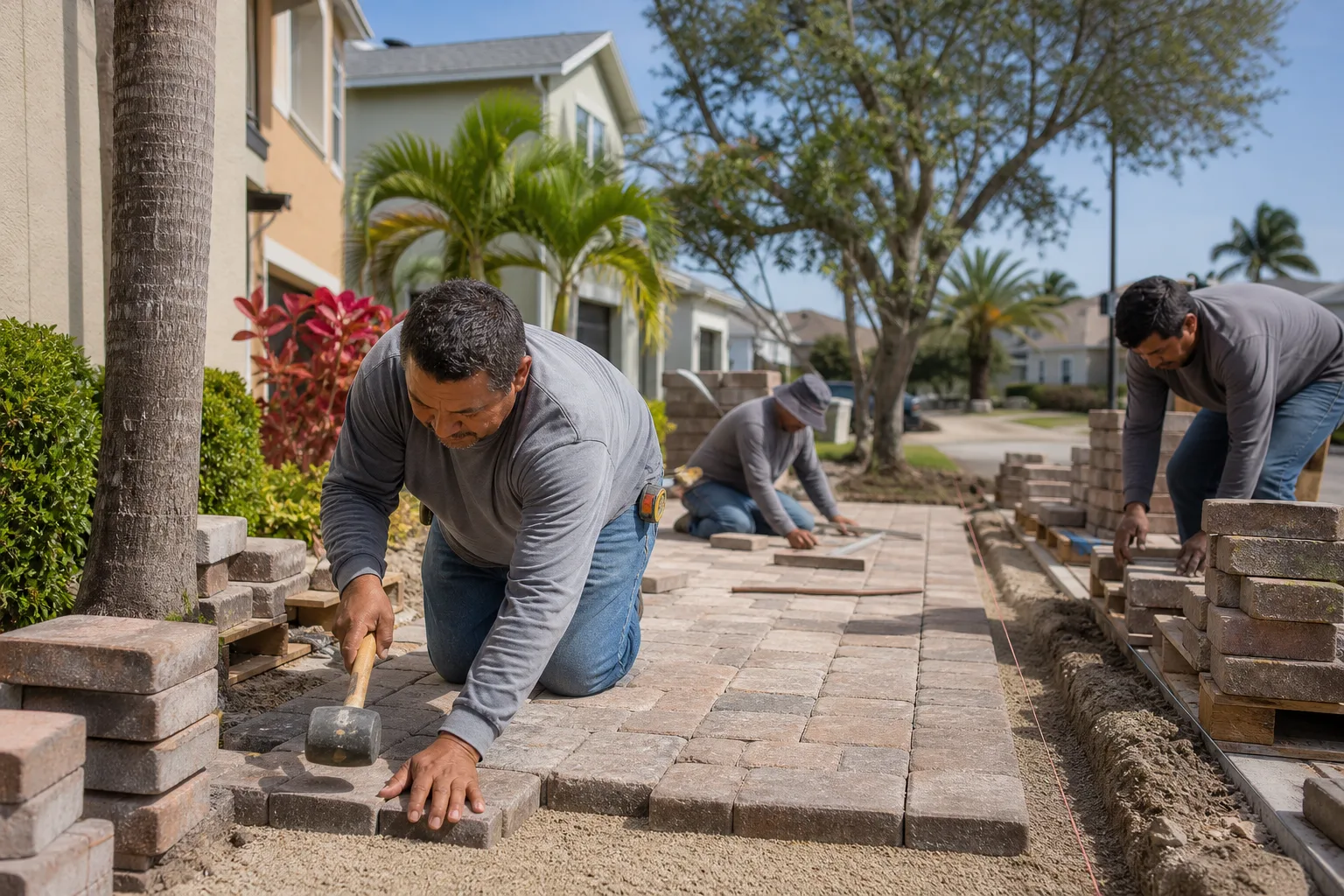
- Re-sand the joints. This is the core November task. After five months of rain, joints will be low. Use a proper polymeric or kiln-dried joint sand and sweep it into the gaps, then vibrate it down with a plate compactor or a hand tamper on small areas.
- Check for displacement. Walk the driveway edge to edge. Any paver that has lifted, tilted, or shifted needs to come up and be re-bedded now. Storm surge and wind debris cause local displacement, and it almost always gets worse in the dry season.
- Look for moss and algae growth along the north side. Kendale Lakes humidity means the shaded side of a driveway is where moss starts. Handle it in November before it gets a foothold.
November is also the best window to evaluate whether the driveway needs a fresh seal. If the water-bead test (covered below) says the sealer is still working, leave it alone. If it isn’t, the dry season is the right time to reseal. Sealing in November or early December, when rain is less frequent, gives the sealer the 48 to 72 hours of dry time it needs to cure properly.
When Pavers Actually Need Resealing (The Water-Bead Test)
Resealing is the number one area where homeowners get oversold. A paver driveway in Kendale Lakes does not need to be sealed every year, and a contractor who says otherwise is either working from a generic calendar or padding the job. A properly applied sealer on a well-maintained driveway should last two to three years. Sometimes longer, depending on the sealer type and the sun exposure.
You don’t need a professional to tell you when it’s time. You need a cup of water.
The Water-Bead Test
- Pour about a half-cup of water onto a dry section of the driveway, ideally in a high-traffic area rather than the edge.
- Watch what happens. If the water beads up and rolls off in droplets, the sealer is still doing its job. Leave it alone.
- If the water spreads out and darkens the paver surface within a few seconds, the sealer is gone or has worn through. That section needs resealing.
- Test three or four spots, because traffic wears sealer unevenly. High-use areas like the apron at the street will fail first.
That’s the entire test. If a contractor tells you the driveway needs sealing and the water still beads, you’re being upsold. The fix is to schedule the work for the right time of year, not to add an unnecessary coat that traps moisture in the joints underneath.
What Goes Wrong When You Seal at the Wrong Time
In Kendale Lakes, the wrong time to seal is any point between June and early October. The sealer needs a dry, clean, low-humidity window to cure. Sealing during the wet season almost always means trapping residual moisture in the joint sand and the paver surface, which shows up as a cloudy, milky, or flaking finish within a few months. Removing that sealer is a strip-and-redo job. The upside of waiting is a clean finish that lasts the full two to three years.
What Sealer to Use
For a Kendale Lakes driveway, we recommend a breathable, water-based penetrating sealer over a heavy film-forming acrylic. The film-forming types look glossy for a year but trap moisture and get slick when wet, which is a real problem in a place that rains hard every afternoon. Penetrating sealers let the pavers breathe while still repelling water at the surface. If you’re having the sealer applied by a crew, ask which type they’re using and why. Any professional should have a clear answer.
The Annual Weed and Moss Protocol for Kendale Lakes Humidity
Weeds in paver joints are not just a cosmetic problem. Their roots push the joint sand apart, which lets more sand wash out, which opens the joints for more weeds. In Kendale Lakes, with our humidity and daily rain in the wet season, the cycle runs fast. A hands-off joint can go from a light sprouting to a full weed mat in two months during the summer.
The Protocol
- Remove weeds by hand or with a joint knife, not a pressure washer. Pressure washing the joints to remove weeds also removes the joint sand. Pull them by hand, or use a stiff wire brush on the surface. For persistent roots, use a joint-sand-safe spot treatment.
- Choose the right killer. Standard broadleaf herbicides, used carefully, kill the weed without damaging paver surface. Avoid bleach and heavy acetic acid (vinegar concentrate), which etch certain paver finishes and drive the sand pH out of range. If you’re unsure, use a product labeled for hardscape paving.
- Re-sand immediately after weed removal. Every weed you pull leaves a gap where the sand was. Top off the joint with fresh sand before the next rain, or the weed will simply come back.
- Handle moss and algae with a light biocide, not a heavy pass. A dilute bleach solution (about one part bleach to four parts water) sprayed on moss and left for fifteen minutes before a light rinse will kill it without harming the joints. Repeat every three months in the wet season on shady sides.
- Address the drainage, not just the weeds. Weeds and moss both thrive where water sits. If a specific strip of the driveway is greener than the rest, it’s a low spot. Fixing the drainage fixes the weed problem long term.
A paver driveway that gets a quarterly weed pass in the wet season stays on top of the problem. Skip a quarter, and the summer heat plus daily rain will undo two years of maintenance in a few weeks.
The 5-Year Inspection: What Homeowners Overlook
Around the five-year mark, a paver driveway in Kendale Lakes has been through five hurricane seasons and five dry seasons. That’s enough time for the small structural items that never show up on a maintenance checklist to become visible. These are the items we see most often get missed, and each one has a specific fix.
Edge Restraints
The edge restraint is the concrete curb or spiked plastic lip that holds the perimeter pavers in place. Over time, especially in soil that gets saturated in the wet season, the restraint can lift, crack, or pull away from the driveway edge. When it does, the outer row of pavers starts to creep outward, the joints widen, and the whole field loses its interlock. Check the restraint at least annually, and every year after year five. A crack running through a concrete edge restraint is a repair-now item.
Curb Transitions
Where the driveway meets the street curb, the transition is the weakest point in the whole system. This is where storm runoff concentrates, where the pavement settles fastest, and where displacement shows up first. If the curb transition is dropping below the street grade, water will flow toward the driveway instead of away from it. That’s a repair that has to be done before the next wet season.
Apron-to-Street Joints
The apron is the sloped transition between the flat driveway and the street. Over five years, especially on a driveway with any traffic load, the apron pavers can settle relative to the flat area. The failure is subtle at first, a slight drop you feel when you drive out. By the time it’s visible, the joint sand underneath the apron is usually gone, and water has been running into the base. An apron reset is a moderate job if it’s caught early; if it’s left, it becomes a full apron rebuild.
Base Settlement
If a full section of the driveway looks like it’s dropped below the surrounding pavers by a quarter inch or more, the base underneath has likely settled. Kendale Lakes’s high water table and periodic heavy rain make this the most common structural problem in older paver driveways. Spot fixing the pavers on top of a settled base doesn’t work. The section has to come up, the base regraded, and the pavers re-laid.
At the five-year mark, a professional walkthrough is worth doing even if nothing looks wrong. The inspection is fast, and it’s much cheaper than discovering a base settlement issue during a storm.
Month-by-Month Schedule at a Glance
Here’s the full year condensed. This is the schedule we recommend for a paver driveway in Kendale Lakes, adjusted for our climate rather than a national average.
- January: Visual check for joint sand loss after the dry start; check edge restraints.
- February: Mid-dry-season check. Water-bead test if it’s been two years since the last seal. Weed pass.
- March: Deep clean before the rains; check drainage channels for winter debris.
- April: Edge restraint inspection; check curb transition for dropping; schedule May inspection.
- May: The full pre-hurricane checklist. Top off joint sand, clear drainage, photograph the driveway, check for loose pavers.
- June: Hurricane season opens. Post-storm debris removal after any named system. Don’t reseal.
- July: Weed and moss pass after the first heavy month of rain; spot re-sand any joints that have washed out.
- August: Repeat weed pass; re-sand washed joints; check for localized displacement after storms.
- September: Peak of the season. Debris removal, spot re-sanding, watch for standing water.
- October: Hurricane season winds down. Weed pass; check the full driveway for shifts and lifts.
- November: The full post-hurricane reset. Pressure wash, re-sand, re-bed any displaced pavers, evaluate sealing.
- December: The right window to reseal if the water-bead test says it’s time. Cure the sealer before the dry season.
Notice what’s missing from this schedule: sealing every year. Once every two to three years is right for Kendale Lakes. Resanding twice a year, in May and November. Weed work quarterly in the wet season. Everything else is responsive.
If your driveway runs alongside a new fence, the fence foundation can shift the drainage pattern for the first two seasons. We’ve seen that cause extra sand washout on the fence side, so it’s worth reading our Fence Installation in Kendale Lakes guide for how the two interact.
Repair vs. Replace: Reading the Warning Signs
A paver driveway in Kendale Lakes can last 25 to 30 years with proper maintenance. But there are specific warning signs that mean repair isn’t going to solve the problem. Knowing which is which saves homeowners thousands of dollars on the wrong fix.
Signs You Need a Repair (Fast Fixes)
- One or two pavers are loose or slightly lifted, with intact joints around them.
- Joint sand has washed out in a specific strip but the pavers themselves are level.
- A small area of moss or algae is growing but the pavers underneath are intact.
- The edge restraint has cracked but the outer pavers haven’t moved.
- The sealer is worn in a traffic pattern but the pavers underneath are fine.
Signs You Need More Than a Repair
- A whole section (several square feet) has dropped below grade, or you can feel it dip when you drive over it.
- Pavers are heaving upward with joints that are wider at the top than the bottom.
- Water pools on the driveway after heavy rain and doesn’t drain within a few hours.
- The base under a section is visibly soft or spongy when walked on.
- The edge restraint has separated from the driveway by more than about a half inch.
When you see any of the second list, the fix is a localized lift-and-rebase, not a spot repair. Doing spot work over a bad base is a temporary scab that comes off with the next storm. In Kendale Lakes, that’s often within six to twelve months.
A full driveway replacement is only necessary if more than about a third of the driveway is failing, or if the base has lost structural integrity across most of the area. Anything less, repair is the answer, and it’s usually a one- to two-day job.
Common Mistakes to Avoid
- Sealing during the wet season. A July or August seal in Kendale Lakes traps moisture in the joint sand and produces a cloudy, milky surface within months. The fix is a strip-and-redo that costs more than skipping the sealer. Seal in November or December if the water-bead test says it’s time.
- Pressure washing the joints hard. High-pressure washing on the joint lines blasts out the joint sand and turns a cosmetic cleanup into a resanding job. Keep the pressure low and the wand angled at the paver face, not into the joint.
- Skipping the pre-hurricane sand top-off. Empty joints before a storm means the pavers lose interlock and shift more during wind and rain. The May sand top-off is what makes the June-through-November season survivable.
- Ignoring the edge restraint. A cracked edge restraint lets the outer pavers creep and the whole field widen. Homeowners notice the visible pavers but not the restraint, which is the actual problem.
- Treating weeds without re-sanding. Pulling weeds leaves a gap that either fills with rain or fills with a fresh weed. Every weed pull has to be followed by joint sand.
- Replacing a whole driveway when a section will do. A quarter of a paver driveway failing is a section repair, not a driveway replacement. On a typical Kendale Lakes driveway, the difference is thousands of dollars.
- Believing sealer is an annual must. A properly sealed paver driveway in South Florida holds its finish for two to three years. Yearly resealing is a common upsell; the water-bead test is the real answer.
See the difference
 Before
 After
 Before
 After
 Before
 After
When to Call a Professional
Most of the schedule in this guide is within reach of a homeowner with a hose, a broom, and a bag of joint sand. Call a professional when the work involves lifting pavers, resetting edge restraints, correcting base settlement, or managing a full post-storm reset across a large area. Those jobs need the right compaction and base material, and a wrong fix makes the next problem worse.
Specifically, call us if you’re seeing any of the following:
- A section of the driveway has dropped more than a quarter inch below the surrounding pavers.
- Water is pooling against the house or garage during heavy rain because the slope has shifted.
- The apron pavers are loose or the joint between the apron and the street has opened up.
- You can feel the driveway dip when you drive over a specific spot.
- A storm has displaced multiple pavers and the underlying base is exposed.
Groundwork Construction Co. of Kendale Lakes offers free estimates in Kendale Lakes. Call (844) 834-8961 and we’ll walk the driveway with you, run the water-bead test, and put the diagnosis in writing before any work starts. Every paver project we do is covered by our 730-Day Done Right Promise, and our technicians have up to 12 years of experience with Florida paver systems. If you’re planning a bigger project, our Home Additions & ADU in Kendale Lakes team can also walk any drainage changes your addition might create for the driveway.
Frequently Asked Questions
A paver driveway in South Florida typically needs sealer every two to three years, not every year. The right test is the water-bead test: pour a half cup of water on a dry area of the driveway and watch whether it beads up or spreads. If it beads, the sealer is still working and you can skip the reseal. If it spreads and darkens the paver surface within a few seconds, it’s time. The best window for sealing in Kendale Lakes is November through December, after hurricane season winds down and before the dry-season heat builds. Call (844) 834-8961 if you want us to run the test with you; estimates are free.
Pressure washing is safe if you keep the pressure moderate and angle the wand at the paver face, not directly down into the joint lines. High pressure into the joints blasts the joint sand out, which turns a simple cleaning into a full resanding job. A gentle pass with a wide nozzle is enough for routine cleanup. We use lower pressure throughout the work and top off the joints whenever we finish a wash.
Weeds return because the joint sand is low or because the drainage in that area is pooling water. Pull the weeds by hand (not with a pressure washer), top off the joint with fresh polymeric or kiln-dried sand, and check whether that strip of driveway holds water after a heavy rain. Fix the drainage and the weeds stop coming back. In Kendale Lakes’s humid climate, plan a weed pass every quarter during the wet season, not once a year.
No, and this is the most expensive mistake we see in South Florida. Sealing between June and early October, when the wet season brings daily rain and high humidity, traps moisture in the joints and produces a cloudy, milky finish that requires stripping and redoing. Wait until November or December, when you can rely on a dry 48- to 72-hour cure window. The wait costs nothing; the early seal costs a strip-and-redo.
A properly installed paver driveway with the maintenance schedule in this guide will last 25 to 30 years or more in South Florida. The main factors are base quality, joint sand maintenance, and the two key inspections (May and November). A driveway that skips joint sand top-offs or is sealed in the wet season will show base settlement and paver failure earlier, often in 10 to 15 years. The good news is that most issues we see are local repairs, not full replacement.
Clear the debris immediately, checking the driveway edge for loose pavers as you go, and avoid walking on the joints with heavy equipment until you’ve inspected for lifted pavers. Don’t seal or pressure wash within the first week after a storm; the driveway needs to dry fully first. Once the surface is clean and dry, do a walking inspection for displacement and top off any joints that have washed out. If you find a section that has clearly lifted or shifted, call (844) 834-8961 for an inspection. For the broader property, our Groundwork Construction Co. of Kendale Lakes home page covers the other storm-related checks we run.
The Bottom Line
A paver driveway in Kendale Lakes survives and thrives on three checkpoints a year: the May pre-hurricane inspection, the November post-hurricane reset, and a mid-dry-season weed pass in February. Everything else is responsive. Top off joint sand twice a year, run the water-bead test before any resealing conversation, pull weeds by hand and follow each pull with fresh sand, and keep the edge restraints and curb transitions in sight every year after year five. That rhythm is built for South Florida’s climate, not a national average. It costs a fraction of a premature replacement and keeps the driveway looking right for decades. If you’d rather hand the schedule to a crew that will walk the driveway with you and put the diagnosis in writing, we’re here. Built to last, backed in writing.
Ready to schedule your paver inspection, resealing, or repair? Call Groundwork Construction Co. of Kendale Lakes at (844) 834-8961 for a free estimate. Live person on the line, 24/7. Upfront pricing, no surprises, and every job covered by our 730-Day Done Right Promise.
Written by the team at Groundwork Construction Co. of Kendale Lakes.