Last updated November 17, 2026



Free written scope consultation - allowances, timeline, and change-order rules on paper before a single trade is scheduled
Fence Installation Troubleshooting: Common Problems and How to Fix Them
A leaning fence post is never just a leaning fence post. In our experience across Kendale Lakes, it’s almost always one of three things: a concrete footing that was poured too shallow, a wood post that’s been rotting below the soil line for months, or soil that’s been washing out underneath the post since the day it went in. Each has a completely different fix, and guessing wrong means you’ll be back out there with a shovel in a few months. This guide walks through the failures we see most often on fence installs in Kendale Lakes – and how to tell which repair you’re actually looking at before you spend a dollar on materials.
Quick Answer
Most fence problems come from installation shortcuts, not random wear. A leaning post needs a probe test to separate rot from footing failure; a sagging gate needs hinge adjustment first and frame replacement only if the frame is twisted; warped panels in South Florida’s humidity are often normal expansion, but sealing only helps if the wood was installed with proper gaps. Diagnosis first, repair second, and you’ll fix the right problem the first time.
Styles & brands we work with
- Kitchen remodeling
- Bathroom remodeling
- Home additions & ADU
- Roofing
- Windows & doors
- Driveway & pavers
- Fence
Table of Contents
- How Do You Diagnose a Leaning Fence Post?
- Why Does a Fence Gate Sag Within the First Year?
- Is Warped Fence Paneling Normal or a Structural Failure?
- Why Is My Aluminum or Steel Fence Streaking Rust?
- What Storm Damage Can Be Repaired vs. Reset?
- How Deep Should a Fence Post Footing Be in Kendale Lakes?
- When Is Repair the Wrong Call?
How Do You Diagnose a Leaning Fence Post?
Two tests tell you almost everything, and neither requires digging yet. The probe test checks for rot: push a screwdriver into the post about an inch above the soil line. If it sinks in easily, the wood is rotted at the base and the whole post needs replacing. If it resists hard, the wood is sound and the post is leaning for a different reason.
The soil-pull test checks for footing failure. Grab the post near the top and push it back and forth. If the entire post – including any concrete collar – moves with the soil, the footing was too shallow or the soil around it has eroded. If the post moves but the concrete stays put, the post itself has separated from the footing.
- Probe the post above the soil line with a screwdriver to check for rot.
- Push the post laterally to see whether the concrete footing moves with it.
- Look at the base for soft soil, washout channels, or a crater around the post.
- Check adjacent posts: one leaning post is probably a localized issue; three or four suggests a systemic install problem.
In Kendale Lakes, the second failure is more common than the first. Our soil is sandy, drains fast, and shifts with the rainy season. Posts set in concrete that was mixed too wet or poured less than 30 inches deep will often start leaning in the second or third wet season. We see this most on fences installed in the late spring before the summer rains hit – the concrete cured in dry soil and never fully locked in. Repairs that just straighten the post without addressing the footing will fail again by the following August.
Why Does a Fence Gate Sag Within the First Year?
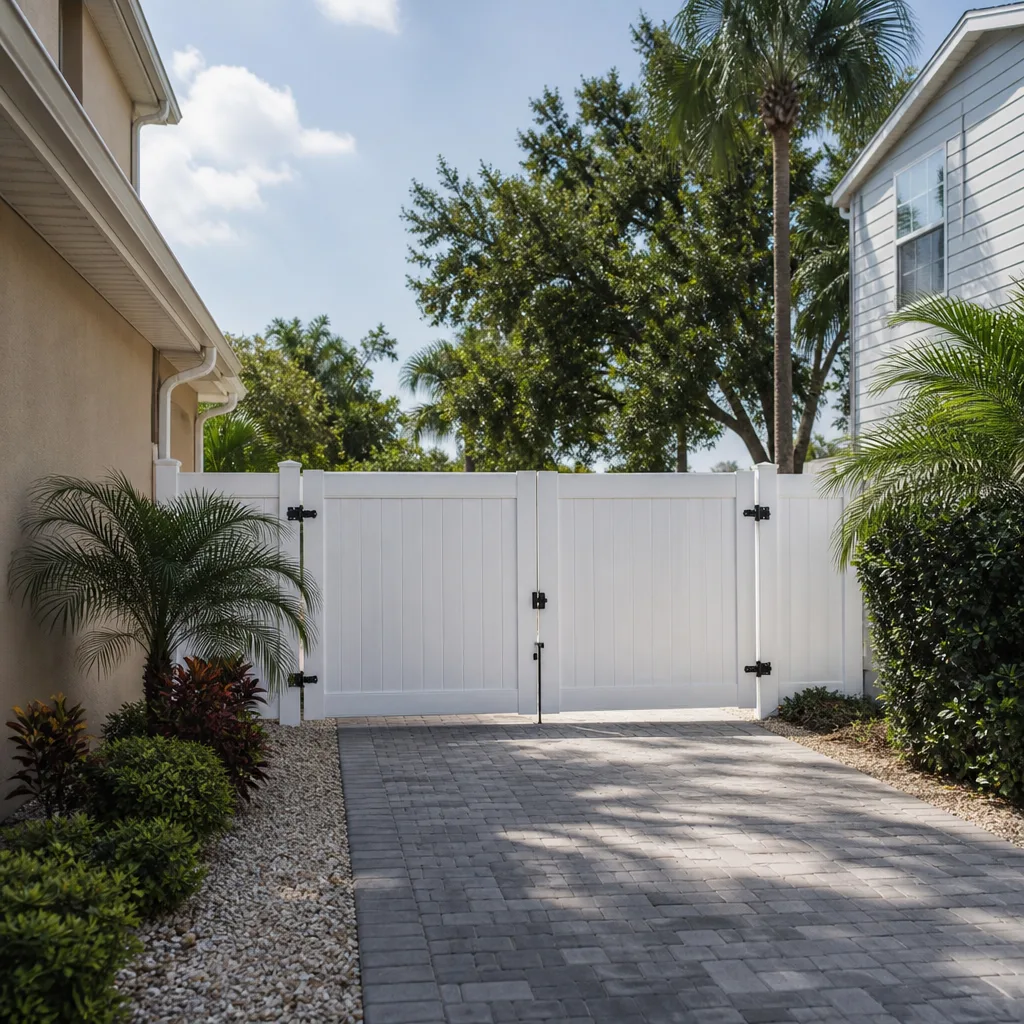
Gate sag in the first year is almost always a build problem, not a wear problem. Wood gates are heavy, and a gate frame that wasn’t built with a diagonal brace, or that was assembled with screws instead of through-bolted joinery, will start to rack under its own weight within a few months. The gate leaf warps along the diagonal, the latch stops lining up, and the bottom edge begins to drag.
Before you assume the whole assembly is failing, do three things:
- Check the hinges. Loose hinge screws are the most common cause of early sag. Tighten and retest. If the screws spin in stripped holes, replace them with longer fasteners or through-bolt the hinge plate.
- Check the hinge side post. If the post itself is leaning, no amount of hinge adjustment fixes the gate. That’s a post problem, not a gate problem.
- Check for a diagonal brace. A gate without a corner-to-corner brace, or with a brace mounted flat against the frame instead of in a true triangle, will sag regardless of how well it’s hung.
The adjustment that fixes most sagging gates: shim the bottom hinge to lift the outside edge of the gate. If that doesn’t hold, the frame itself is twisted and needs to be rebuilt. A metal gate is different – sag usually means the frame itself is closing in or the hinges have wallowed out. Adjusting hinges works on metal gates far more often than on wood, but rusted hinges and stretched hardware are the two cases where replacement is the right call.
Is Warped Fence Paneling Normal or a Structural Failure?
Wood fence panels in Kendale Lakes expand and contract twice a year, and some bowing is expected. Humidity in the summer pushes boards outward, and the winter dry season pulls them back. The distinction between normal and failure comes down to three things: whether the warping is reversible, whether the boards are separating from each other, and whether the posts are moving with them.
Normal expansion: Boards cup slightly, gaps open and close with the seasons, and the panel returns to roughly flat in the dry months. Sealing with a penetrating oil-based stain helps equalize moisture uptake and reduces seasonal movement.
Structural warping: The panel stays warped in both wet and dry seasons, boards are visibly pulling from the rails, or the tops of the boards are curling away from the panel. This usually means the boards were installed too tight with no gaps, the wrong fastener type was used (staples instead of ring-shank nails, or fasteners set too close to the board edge), or the wood was installed wet and shrank.
Sealing only helps on the first category. If a panel is already structurally warped, sealing locks the problem in. The fix is to pull the affected boards, replace them, and reinstall with a proper gap – typically one-eighth inch on pressure-treated pine. In Kendale Lakes, our advice is to install southern yellow pine or cedar with gaps, fasten with ring-shanks or stainless screws, and never count on a sealer to fix an install that was already wrong.
Why Is My Aluminum or Steel Fence Streaking Rust?
Rust streaks on aluminum are almost never the aluminum rusting – aluminum doesn’t rust. What you’re looking at is one of four things: rust bleeding from a steel fastener or hinge; iron particles from a nearby steel fence, sprinkler, or landscaping tool that have landed on the surface and started to corrode; a scratched powder coat that’s exposed the aluminum to surface oxidation; or mineral staining from irrigation water.
Diagnose it in three steps:
- Wipe the rust streak with a white rag. If the streak smears orange, it’s surface contamination and will clean off with a light acid wash.
- Look at each fastener, hinge, and latch. If the rust originates at a screw head, the steel fastener is the source. That’s the fix.
- Check for chips in the powder coat. Chipped powder coat needs touch-up to prevent oxidation, but it doesn’t produce the orange rust streaks people actually complain about.
Fastener replacement is the source fix. Galvanized screws will streak again in our humid, salt-air environment – stainless steel or coated fasteners are the correct replacement. Once the fasteners are swapped, a light acid wash on the aluminum removes existing streaks. In our work across Kendale Lakes, we’ve seen fences that were installed with exterior-grade drywall screws (which are not for exterior use at all) that rusted out and streaked the fence within a single rainy season. Swapping to stainless fasteners ended the problem permanently.
What Storm Damage Can Be Repaired vs. Reset?
Tropical weather in South Florida tells you quickly which posts were set right and which weren’t. The difference between “repairable” and “needs a reset” comes down to three factors: whether the post moved at all, whether the railings are cracked, and whether the concrete collar is intact.
Repairable: One or two panels are bowed but the posts are still plumb. Individual boards are splintered but the rails are intact. A gate is displaced from its latch but the posts haven’t shifted.
Needs a reset: Any post is more than a half inch out of plumb. The concrete collar has cracked or lifted out of the ground. The post base is spongy – that’s rot accelerating after water soaked in.
Needs full replacement: Two or more adjacent posts have lifted or failed, or the fence line’s overall run has shifted. At that point the fix is a new footing, not a repair.
A reset post needs a deeper footing than what was originally installed – 36 to 42 inches in Kendale Lakes sandy soil with a proper concrete mix, not the dry-set or foam products some installers use. Dry-set and foam anchors are what we see fail first after a storm. If the fix is going to hold, the footing needs to go below the frost-and-water line the post originally missed.
How Deep Should a Fence Post Footing Be in Kendale Lakes?
For a standard six-foot wood privacy fence in Kendale Lakes, you want a footing 30 to 36 inches deep and at least 10 inches in diameter in our sandy soil. For gates, corner posts, or any fence in an area that takes wind load, go 36 to 42 inches. That’s deeper than what national “rule of thumb” charts suggest (typically one-third of post height), and there’s a reason – our soil drains fast enough that shallow concrete cures too dry, and our storm season loads the fence more than inland installs are designed for.
Three mistakes we see on footings that end up costing the homeowner a full reset:
- Too wet a concrete mix. Watery concrete in sandy soil just soaks away and never fully cures around the post. Mix it to a thick, scoopable consistency.
- No gravel base. Two to three inches of gravel at the bottom of the hole lets water drain and reduces post rot. Skip it and the post sits in a bucket.
- Post set directly in the dirt. “Just pound it in” installers skip the concrete entirely. Those fences generally hold two or three seasons and then move all at once.
Get the footing right and everything else follows. Skip it and every other problem on this page gets harder to fix. We see far more footing failures than any other single cause of leaning posts in Kendale Lakes. If you’re starting a new fence from scratch, the install details matter more than the fence style you pick – a basic pine privacy fence set in properly poured concrete will outlast a fancier fence set in dry-set anchors every time.
When Is Repair the Wrong Call?
There’s a point where repair becomes a losing cost, and it’s worth knowing where that point sits before you spend money on patches. Three situations generally tip toward replacement:
- More than 20% of the fence line has failed in the last two years. If a quarter of the posts have already moved, the original install was flawed. Patches will just chase the same problem down the line.
- Rot is visible at the top of the post as well as the base. If the whole post is compromised, no footing repair will fix it. The post itself is done.
- The gate frame has been rebuilt twice. A gate that sags twice in less than two years has a fundamental design flaw – undersized frame, no brace, or wrong hardware – and a rebuild will keep the same flaw.
Kendale Lakes has another variable most markets don’t: the type of fence. Aluminum and steel fences rarely need full replacement for any of the problems above – they need fastener swaps and touch-up. Wood fences are the opposite – they can be patched indefinitely but only if the original footing is sound. When a fence line has both a recurring post problem and a panel problem, replacement ends up being the better investment than the same repair repeated in three years. That’s the honest math we walk through with homeowners before quoting anything.
Common Mistakes to Avoid
- Fixing the post without checking the footing. Straightening a post without addressing a shallow footing will be undone by the next rainy season in Kendale Lakes.
- Using drywall screws or interior hardware outside. Exterior installs need exterior-rated or stainless fasteners – anything else streaks and fails in our humidity.
- Sealing a fence before it’s had time to dry out. Pressure-treated pine needs time to dry before sealing; sealing while the wood is still wet locks in the moisture and causes warping and paint peel.
- Ignoring gate braces. A wood gate without a diagonal brace will always sag, regardless of hinge quality.
- Installing boards tight with no gaps. Zero-gap installs warp and split – boards need a bit of room to move.
- Repairing the same post twice. If a post has failed once, the cause is in the ground. Resetting it at the same depth fixes the wrong thing.
- Skipping the permit for a new fence line or a gate opening. Kendale Lakes and Miami-Dade County have setback and height rules that matter for resale and for insurance.
See the difference
 Before
 After
 Before
 After
 Before
 After
When to Call a Professional
Some fence problems are easy to spot and easy to fix on your own – a stripped hinge screw, a warped board, a touch-up on a chipped powder coat. The problems that cost real money are the ones below the ground line. If a post has moved more than half an inch, if concrete collar shows cracks or lift, if the rot runs more than a couple inches above soil line, or if you’re looking at two or more leaning posts on the same run, it’s time to have someone look at the footing. Resetting a post correctly means digging out the old concrete, setting a proper gravel base, and pouring a footing deep enough to survive our storm season. That’s a two-person job with a post-hole digger and a wheelbarrow of concrete, and the cost of doing it wrong is doing it twice. Groundwork Construction Co. of Kendale Lakes offers free estimates in Kendale Lakes for repair, reset, or full replacement – call (844) 834-8961 to schedule one.
Frequently Asked Questions
Fence post repair in Kendale Lakes typically runs $180 to $340 per post for a proper reset with a new footing, and $340 to $550 per post if the old concrete needs to be dug out and the post itself replaced. Full fence replacement runs $28 to $55 per linear foot depending on material and height. Get a written line-item quote before anyone touches a shovel – the number you see should be the number you pay.
It shouldn’t. A written line-item quote from Groundwork Construction Co. of Kendale Lakes locks in the scope and price before work begins, with no change orders and no surprise line items. If the crew discovers something unexpected – a broken rail behind a panel, or a footing that’s deeper than expected – that gets discussed and approved before anything moves forward. Ask for the quote in writing and hold whoever’s doing the work to it.
Yes – fence installations that change the fence line, height, or gate openings need to meet Miami-Dade County setback and height requirements, and any permit required for the scope gets pulled before work starts. If you’re replacing an existing fence in the same footprint at the same height, a permit is often not required, but the setback and height still have to be compliant. We confirm what applies to your specific property during the estimate.
Most single post resets take half a day, including digging out the old concrete, setting a new gravel base, and pouring a new footing. Fence panels can usually be reinstalled the same day, though the concrete needs 24 to 48 hours to cure before the fence carries full wind load. A storm-damaged run of three or more posts may take a full day or two depending on access.
Push a screwdriver into the post about an inch above the soil line. If it sinks in with light pressure, the wood is rotting and the post needs replacing. If it resists hard, the wood is sound and the lean is a footing issue – which is fixable without a new post. In Kendale Lakes, both problems can look identical from the outside, so the probe test is worth doing before you call anyone.
Sometimes. If one or two posts shifted but the rails and panels are intact, repair is often the right call. If three or more adjacent posts have moved, or the original footing depth was already failing before the storm, replacement of the affected run is more cost-effective than a series of repairs. Groundwork Construction Co. of Kendale Lakes offers free storm damage estimates in Kendale Lakes – call (844) 834-8961 and we’ll walk the fence line with you.
The Bottom Line
Fence problems almost always trace back to one of three install shortfalls: shallow footings, cheap fasteners, or gates built without a brace. The leaning post, the sagging gate, the streaked aluminum, the storm-broken panel – each is a predictable outcome of one of those three. Diagnose before you repair, and the fix you choose will hold. Get the footing to 30 to 42 inches with a gravel base, use stainless fasteners on metal, gap boards on wood, and brace every gate. If you’re not sure which failure you’re looking at, that’s what estimates are for. Groundwork Construction Co. of Kendale Lakes brings the same 730-Day Done Right Promise to every fence repair and installation we take on – if it’s not done right, we make it right. Call (844) 834-8961 to schedule your free estimate.
Written by the team at Groundwork Construction Co. of Kendale Lakes.